
How to Choose a DC Fast Charging Station: A Complete 2026 Buyer's Guide
Choosing the right DC fast charging station is one of the most consequential purchasing decisions for fleet operators, charging network developers and site owners. Unlike AC charging, a DC fast charger is a complete power-electronics system that has to match your vehicles, your grid connection, your climate and your back-office software. Specify it badly and you either overpay for capacity you never use, or you strand drivers on chargers that are slower than the label promised.
This guide works through the seven decisions that determine whether a DC charging installation performs — based on the specifications that matter most to buyers across Europe, North America and the Middle East.
What Is a DC Fast Charging Station?
A DC fast charging station converts three-phase AC power from the grid into high-voltage DC and feeds it directly to the vehicle battery, bypassing the onboard AC charger. That is why a DC unit can add far more range per hour than an AC wallbox: the power electronics that limit AC charging speed are moved out of the car and into the station.
In practice, DC stations are built in three broad power classes:
- 30–60 kW — compact units for retail, workplace and destination charging, where dwell time is 40–90 minutes.
- 120–180 kW — the current mainstream for highway corridors and public fast-charging hubs.
- 240–350 kW and above — high-power chargers for heavy-duty trucks, buses and next-generation passenger EVs with 800 V architectures.
The right class depends less on the vehicles on the road today than on the vehicles you expect to serve in three to five years.
Step 1 — Match Output Power to the Site, Not the Brochure
Power output is the headline number, but the number that actually matters is delivered power. A 180 kW charger only delivers 180 kW when the vehicle, the cable, the connector and the battery state of charge all allow it. In practice:
- A vehicle with a 400 V architecture often caps out well below the station rating.
- Above roughly 80% state of charge, charging power tapers sharply on almost every EV.
- Dual-gun stations usually share a single power cabinet, so two cars charging at once can each see less than half the rated output.
For a retail or workplace site with predictable dwell times, a 60 kW unit with dual guns is often a better commercial choice than a single 120 kW unit. For highway corridors, specify at least 150 kW per gun and confirm the sharing behaviour in writing with your supplier.
Step 2 — Pick the Right Connector Standard
Connector choice is driven by where the charger will be deployed, not by preference:
- CCS1 (Combo 1) — North America and South Korea.
- CCS2 (Combo 2) — the European Union and most other markets.
- GB/T — mainland China.
- NACS — the North American standard now being adopted by most major automakers.
- CHAdeMO — legacy Japanese vehicles; still relevant for retrofit projects.
Many suppliers offer dual-connector configurations (for example CCS2 plus CHAdeMO, or CCS1 plus NACS) on a single pedestal. If you operate across regions, confirm that the connector assembly and the cable rating are certified for the market you are installing in — the DC cable is a safety-critical component, not an accessory.
Step 3 — Confirm OCPP Compatibility Before You Sign
Open Charge Point Protocol (OCPP) is what lets your charger talk to a charging management system (CMS) or a roaming platform. Without OCPP, every charger becomes an island.
Two versions dominate the market today: OCPP 1.6J, the mature and universally supported standard, and OCPP 2.0.1, which adds smart charging profiles, ISO 15118 Plug & Charge support and richer device modelling. A practical rule for 2026: require OCPP 1.6J as a minimum, and ask explicitly whether the firmware supports 2.0.1 on the same hardware. A charger you cannot upgrade is a charger you will replace.
Step 4 — Choose a Cooling Method
Cooling is the main determinant of both reliability and maintenance cost at high power:
- Natural / forced-air cooling — simple, low cost, well suited to 30–120 kW units in moderate climates.
- Liquid-cooled cables — required above roughly 250 kW, because an air-cooled cable would be too heavy for a driver to handle safely.
- Liquid-cooled power modules — improve derating behaviour in hot, dusty or coastal environments.
If your site regularly exceeds 35 °C ambient, ask your supplier for the derating curve, not just the rated output.
Step 5 — Check Environmental Protection
Outdoor DC chargers should carry at least IP54 for the enclosure, with IP55 or IP65 preferred for coastal or high-dust locations. Inlet filters, condensation management and anti-corrosion treatment on the cabinet are the details that separate a five-year asset from a fifteen-year one. For flood-prone sites, specify an elevated plinth rather than relying on the enclosure alone.
Step 6 — Verify Certifications
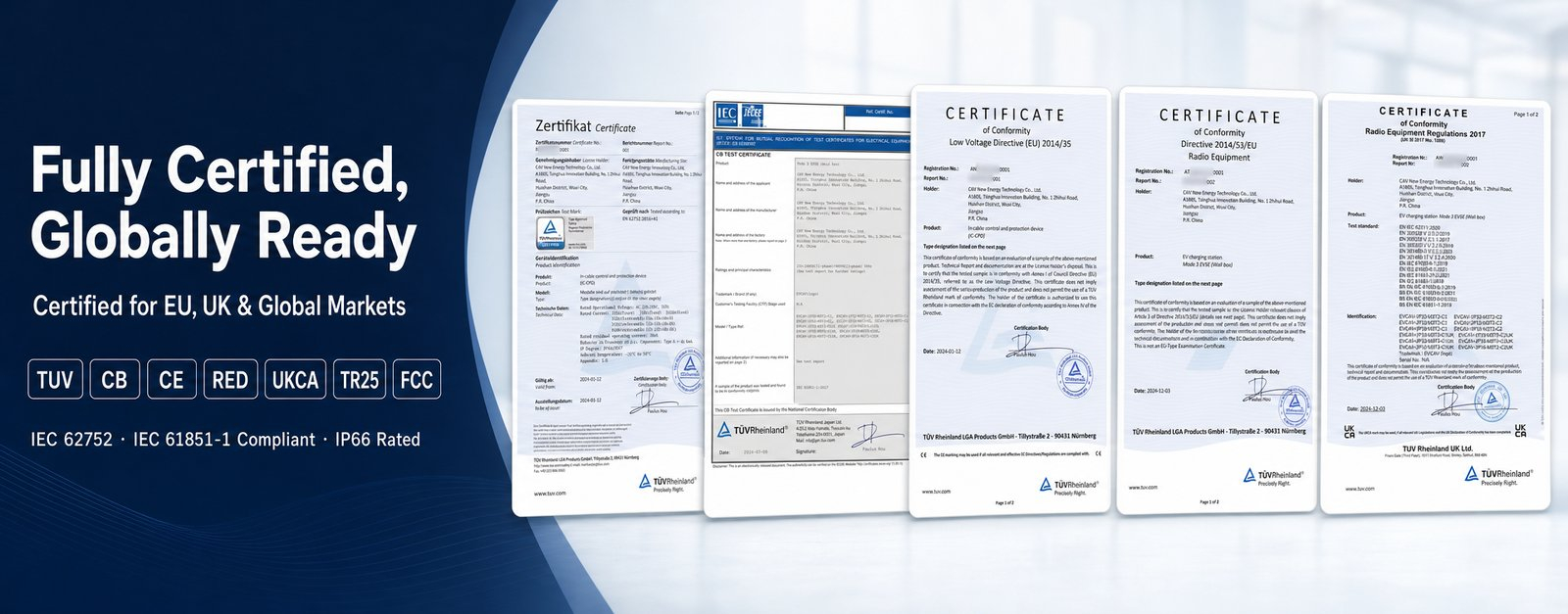
Certification is a market-access requirement, not a formality. Expect to see:
- CE — European Union market access.
- UL or ETL — North American market access.
- IEC 61851 / IEC 62196 — the underlying charging and connector safety standards.
- RoHS — hazardous-substance compliance.
- TÜV or equivalent third-party marks — independent verification that the above were actually tested, not just declared.
Request the certificate numbers and verify them with the issuing body. This is the single fastest way to filter out suppliers who cannot support a real project.
Step 7 — Decide Between Single and Dual Gun
Dual-gun stations reduce civil works, cabling and footprint per connector, which is why most new public sites use them. The trade-off is power sharing: two vehicles charging simultaneously will split the available output unless the station uses independent power modules per gun. Ask your supplier which of the two architectures they use, and check that the answer is consistent with the datasheet.
Frequently Asked Questions
How long does a DC fast charging station take to charge an EV?
At 60 kW, most passenger EVs move from 20% to 80% state of charge in roughly 40–60 minutes. At 150 kW, the same window typically takes 20–30 minutes. The exact figure depends on the vehicle's maximum acceptance rate and its charging curve, not only on the station.
Can a DC fast charger be installed on a standard commercial supply?
It depends on the power class. A 60 kW unit is commonly deployed on a three-phase 400 V supply with a modest upgrade, while 150 kW and above usually require a dedicated transformer or a site capacity study. Always confirm available capacity with the local distribution network operator before ordering.
What is the difference between AC and DC charging?
AC chargers rely on the vehicle's onboard charger to convert power, which limits them to roughly 7–22 kW. DC chargers do the conversion in the station and can deliver 30 kW to more than 350 kW, at the cost of higher hardware, installation and grid-connection requirements.
Does OCPP compliance affect charging speed?
No. OCPP governs communication between the charger and the management platform. It affects smart charging, billing, remote diagnostics and roaming — not the maximum power the station can deliver.
Choosing a DC Fast Charging Station Supplier
Once the specification is clear, the remaining risk is the supplier. Look for a manufacturer that offers the full range — from 30 kW destination units to 240 kW high-power cabinets — so that your network can grow without changing vendors, and that supports both CCS and GB/T connectors with OCPP firmware you control.
Wuxi Bestar Technology manufactures DC fast charging stations from 30 kW to 240 kW with CCS1, CCS2, GB/T and NACS connector options, OCPP 1.6J and 2.0.1 support, and CE, UL and TÜV certified product lines. OEM and ODM programmes are available for network operators and distributors.
If you are specifying a project, send us your site parameters — grid capacity, expected vehicle mix and dwell time — and we will recommend the power class and configuration that fits.
You may also be interested in our guides to EV charging connector standards and OCPP compliance, or in our home energy storage systems for sites that need on-site generation buffering.
 How to Size a Home Energy Stor
 LiFePO4 vs NMC Batteries for H
 What Is OCPP? Why 1.6J and 2.0
 CCS1 vs CCS2 vs GB/T vs NACS: