
How to Size a Home Energy Storage System: A Practical kWh Guide
Undersized, and the battery disappoints every evening. Oversized, and half of your investment never gets cycled. Sizing a home energy storage system is the step where projects are won or lost — and it needs about thirty minutes and one year of electricity bills.
Step 1 — Establish Daily Consumption
Take your annual electricity consumption in kWh and divide by 365. Most European households land between 8 and 15 kWh per day; North American households with electric heating and cooling are often higher.
If you do not have bills, estimate from appliances: refrigeration runs continuously, while cooking, laundry, water heating and EV charging arrive in concentrated blocks. A clip-on energy meter on the main circuits for one week will give you a better number than any online calculator.
Step 2 — Decide What the Battery Must Cover
This is the question people skip, and it changes the answer by a factor of three:
- Self-consumption only — store midday solar surplus for the evening. Typically 30–60% of daily consumption.
- Evening + overnight — cover the hours the PV array is dark. Often 50–80% of daily consumption.
- Full backup — run the whole house through an outage, including heavy loads. Requires both capacity and enough inverter power for the surge.
Define the mission before you pick the hardware.
Step 3 — Convert Coverage into kWh
Multiply daily consumption by your coverage target, then apply a usability factor. Batteries are not discharged to zero, and inverter losses take a few percent:
Required capacity (kWh) ≈ Daily consumption × Coverage ÷ 0.9
Worked example: a household using 12 kWh/day that wants 70% evening coverage needs roughly 12 × 0.7 ÷ 0.9 ≈ 9.3 kWh of usable capacity — a 10 kWh-class system.
Step 4 — Match the Solar Input
A battery that never fills is as wasteful as one that never empties. Check that your PV array can realistically deliver the charge the battery needs:
Required PV surplus (kW) ≈ Battery kWh ÷ expected sun hours
For a 10 kWh battery and four effective sun hours, roughly 2.5 kW of otherwise-exported solar is needed per charging cycle. If your array is smaller, reduce the battery size or accept slower cycling — the maths is honest about it.
Step 5 — Check the Inverter
Three checks, in order of how often people get them wrong:
- Continuous power: can the inverter run the house’s steady loads plus the battery’s rated output simultaneously?
- Surge power: pumps, compressors and air conditioners draw several times their rated power for a second at start. The inverter must survive it.
- Battery voltage and communication: the battery’s nominal voltage (for example 25.6 V or 51.2 V systems) and its CAN/RS485 protocol must be on the inverter’s compatibility list.
Mismatched communication protocols are the single most common cause of “the battery works but the system does not” support tickets.
Step 6 — Plan for Growth
Choose a system that can expand: modular batteries that stack or parallel, an inverter with headroom, and a BMS that supports additional packs. Households add heat pumps and EV chargers at a remarkable rate; a battery you cannot extend becomes the bottleneck.
Worked Example, End to End
A four-person household, 12 kWh/day, 8 kW solar, evening coverage plus outage protection for lights, refrigeration and internet:
- Coverage target 70% → roughly 9–10 kWh usable capacity.
- Backup essentials ≈ 0.8 kW average → a 3–5 kW hybrid inverter is sufficient; surge check on the fridge and water pump.
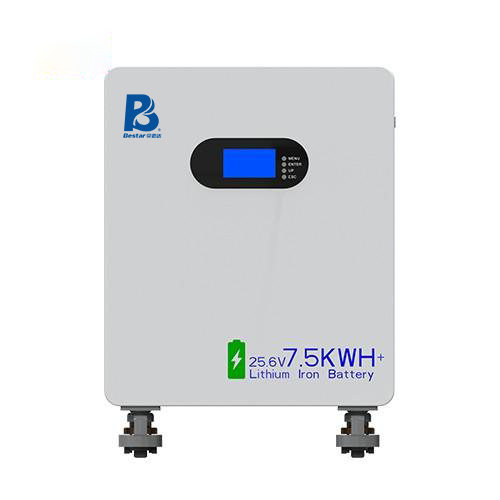
- A 10 kWh-class wall-mounted LiFePO4 battery with a 5 kW hybrid inverter covers the mission with room to grow.
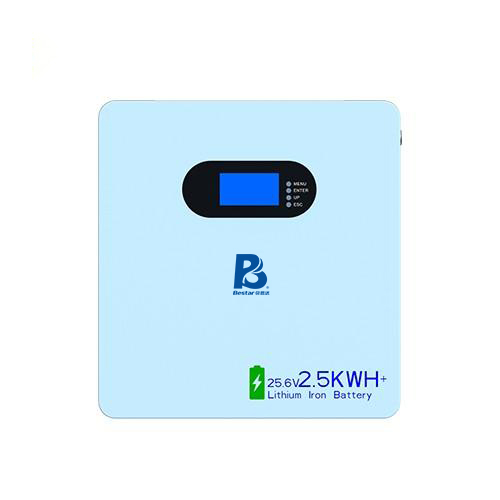
Systems in this class — modular wall-mounted LFP batteries with matched hybrid inverters — are exactly what Bestar’s home storage line is built around.
Frequently Asked Questions
Should I size for one day of autonomy?
For grid-connected homes, no — one evening is usually the economic optimum. Full-day autonomy makes sense for off-grid homes or areas with frequent extended outages, and it typically means 1.5–2× the capacity.
Does a bigger battery damage my solar investment?
Not damage, but an oversized battery cycles shallower, and capacity you never use is capital you never recover. Size to the coverage target from Step 2, not to the biggest cabinet available.
Can I add more batteries later?
Usually yes, if the system was designed for it — parallel-capable battery modules and an inverter with spare capacity. Confirm both before the first purchase, not after.
What maintenance does a home battery need?
Essentially none beyond keeping vents clear and firmware updated. The BMS handles balancing automatically.
Getting a Configuration Confirmed
If you share your daily consumption, coverage goal and local sun hours with Bestar’s engineering team, we will return a recommended battery capacity, inverter size and expansion path — before you commit to any hardware.
Related reading: why we build on LiFePO4 chemistry, and what OCPP compliance means if you are pairing storage with EV charging.
 How to Size a Home Energy Stor
 LiFePO4 vs NMC Batteries for H
 What Is OCPP? Why 1.6J and 2.0
 CCS1 vs CCS2 vs GB/T vs NACS: