
LiFePO4 vs NMC Batteries for Home Energy Storage: Which Should You Choose?
Every home energy storage project eventually hits the same question: lithium iron phosphate (LiFePO4, often shortened to LFP) or nickel manganese cobalt (NMC)? The answer shapes the system’s lifespan, safety profile, physical size and price — and it is not the same answer for every project.
The Two Chemistries in One Paragraph
Both are lithium-ion chemistries; the difference is the cathode material. LiFePO4 uses iron phosphate — an abundant, thermally stable material. NMC uses a blend of nickel, manganese and cobalt, which stores more energy per kilogram but is intrinsically less stable at high temperatures.
Everything else in this comparison follows from that single material difference.
Safety: LiFePO4’s Home-Turf Advantage
For a battery that lives on a wall in a family home, thermal stability is not a spec-sheet footnote — it is the whole ballgame.
- LiFePO4’s olivine structure releases very little oxygen when abused, which is why thermal runaway events are rarer and typically less energetic.
- NMC stores more energy in the same volume, and that energy has to go somewhere if a cell fails.
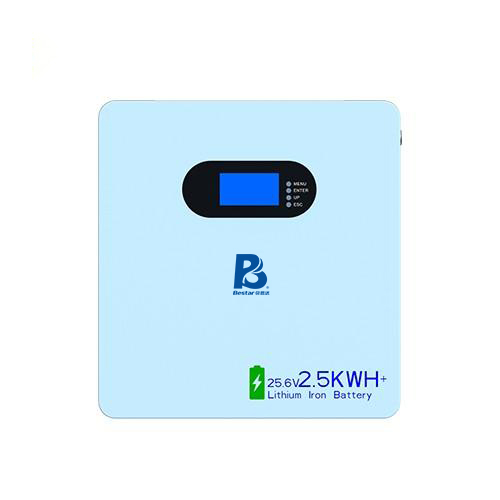
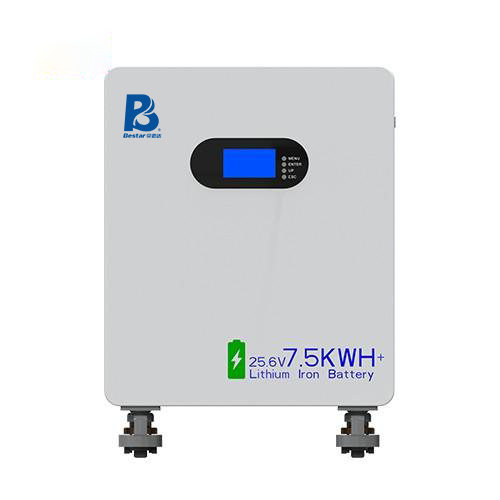
This is the main reason residential storage has consolidated around LFP over the past several years, and why most wall-mounted home batteries you see on the market today — including Bestar’s range — are LiFePO4.
Cycle Life
A home battery is cycled daily for a decade or more, so the number of full charge-discharge cycles before capacity fades is decisive.
- LiFePO4 cells are typically specified for several thousand cycles, and commonly outlast the warranty period written on the box.
- NMC cells generally reach fewer cycles at the same depth of discharge.
Translated into years: a well-sized LFP system usually remains useful past the ten-year mark, which is the horizon most homeowners actually care about.
Energy Density: Where NMC Wins
NMC packs more energy into less weight and volume — often 20–30% more per kilogram. That is why it dominates where space and weight are the binding constraints: handheld tools, electric vehicles, drones.
In a garage or utility room, floor and wall space is usually available, so LFP’s lower density rarely matters. It matters in tight installs — apartments, caravans, marine applications — where every centimetre is negotiated.
Temperature Behaviour
LFP tolerates heat well but charges poorly below freezing unless the system includes a heating element. NMC handles cold somewhat better but dislikes sustained high ambient temperatures — which is exactly what a wall battery in a hot climate endures.
If your project is in a hot region, LFP is the natural default. If it faces sub-zero charging regularly, specify an LFP system with self-heating rather than switching chemistry.
Cost
LFP has a per-kWh cost advantage that has widened as iron-phosphate production has scaled. For a fixed budget, LFP typically buys more usable kWh — and more cycles over which to earn that money back.
NMC’s premium buys energy density. If density is not your constraint, that premium buys you nothing.
Side-by-Side
| Criterion | LiFePO4 (LFP) | NMC |
|---|---|---|
| Thermal safety | Excellent | Good, needs more protection |
| Cycle life | Higher (several thousand) | Lower at same DoD |
| Energy density | Moderate | High |
| Cold-weather charging | Needs heating below 0 °C | Better, but heat-sensitive |
| Cost per kWh | Lower | Higher |
| Typical residential fit | Wall/garage installs | Space-constrained installs |
Frequently Asked Questions
Is LiFePO4 really safer than NMC?
Its chemistry is inherently more thermally stable, which materially reduces the risk and severity of thermal runaway. Good system engineering — BMS quality, cell matching, enclosure design — matters for both chemistries, but LFP starts from a safer base.
How long will a LiFePO4 home battery last?
Well-managed LFP systems are typically designed for a service life of ten years or more, with capacity gradually declining over several thousand cycles. The exact figure depends on depth of discharge, temperature and charge rates — ask your supplier for the cycle-life curve, not just the warranty.
Can I mix chemistries in one system?
No. LFP and NMC have different voltage curves and charging requirements and must never be combined in the same battery bank.
Does chemistry affect which inverter I can use?
Most modern hybrid inverters support selectable battery profiles for both LFP and NMC, but always confirm the battery’s communication protocol (CAN/RS485) matches your inverter’s supported list before purchasing either.
The Practical Recommendation
For residential and small-commercial storage, LiFePO4 is the default recommendation: safer chemistry, longer cycle life, lower cost per kWh, and a supply chain that has fully consolidated around it. NMC remains the right answer only where energy density is the governing constraint.
Bestar’s home energy storage line is built on LiFePO4 cells in wall-mounted and rack-mounted formats, with capacities to suit households of different sizes. If you are comparing chemistries for a specific project, send us your load profile and climate and we will recommend the configuration that fits.
Next step: read our guide on how to size a home energy storage system to work out how many kWh your project actually needs.
 How to Size a Home Energy Stor
 LiFePO4 vs NMC Batteries for H
 What Is OCPP? Why 1.6J and 2.0
 CCS1 vs CCS2 vs GB/T vs NACS: