
AC Wallbox vs DC Fast Charger: Which Fits Your Site?
Every EV charging project starts with the same fork in the road: install AC wallboxes, invest in DC fast chargers, or combine both. Choose wrong in either direction and the project suffers — AC-only at a highway site leaves drivers stranded for hours, while DC-only at an office park ties up capital in power electronics that sit idle most of the day.
This guide gives you a decision framework based on the variable that matters more than any spec sheet: how long vehicles actually stay at your site.
The Rule: Dwell Time Decides the Hardware
Charging is simply energy divided by time. The question is how much time you have:
- Parked all day or all night (homes, workplaces, hotels, long-term parking) — a modest AC supply refills a full battery overnight. Speed beyond that adds cost, not value.
- Parked 30–120 minutes (retail, restaurants, gyms, medical centres) — you want a meaningful top-up within one visit. Mid-power DC or high-output AC fits here.
- Parked under 30 minutes (highway corridors, quick-turnover fleets, taxi ranks) — only DC fast charging delivers a useful range gain in that window.
What an AC Wallbox Actually Delivers
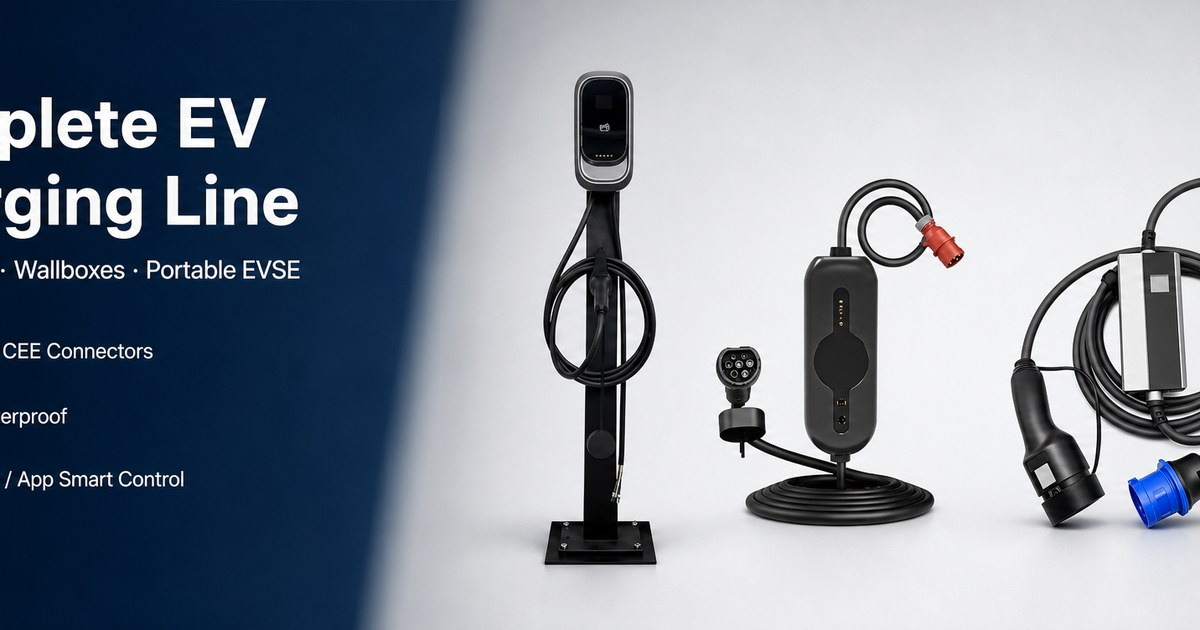
An AC wallbox is a smart, protected version of the charging cable: it hands AC power to the vehicle, and the car’s onboard charger converts it to DC for the battery. Charging speed is therefore limited by the onboard charger, typically in these ranges:
- Single-phase, up to about 7 kW — the standard residential level; adds roughly 30–45 km of range per hour.
- Three-phase, 11–22 kW — common for commercial premises and markets with three-phase household supply; suits vehicles whose onboard chargers accept the higher rate.
The strengths are cost and simplicity: low hardware price per point, modest installation work, minimal maintenance, and gentle treatment of the local grid connection and of vehicle batteries. For any site where cars sit for hours, AC is almost always the economically correct answer.
What a DC Fast Charger Brings
A DC station performs the AC-to-DC conversion itself and feeds the battery directly, so it bypasses the vehicle’s onboard charger entirely. Practical classes, as covered in our DC fast charging buyer’s guide, run from compact 30–60 kW units up to 150 kW+ corridor chargers.
You pay for that capability in four ways: higher hardware cost, a heavier site installation (transformers, switchgear, cabling), higher standing grid charges, and more involved service. None of it is wasted — at a genuinely fast-turnover site, a DC charger can serve several times the vehicles per day that an AC point can.
Scenario-by-Scenario Selection Table
| Site type | Typical dwell | Recommended mix | Rationale |
|---|---|---|---|
| Single-family home | Overnight | 1× 7 kW AC wallbox | Full battery every morning at the lowest cost |
| Multi-family residence | Overnight | Several 7–11 kW AC points, load-managed | Shared building supply spread across residents |
| Workplace | 4–9 hours | AC points for most staff; optional 1–2 DC for visitors and quick turns | Energy per parking bay matters more than speed |
| Retail / restaurant / hotel | 30–90 min | Mid-power DC (with a few AC points as fallback) | Charging becomes a reason to choose the venue |
| Fleet depot, vans and cars | Overnight or shift change | Mostly AC with smart scheduling; DC for opportunity top-ups | Predictable routes let slow charging cover most needs |
| Taxi / ride-hailing base | Short, unpredictable | DC-dominant | Vehicle uptime is the revenue |
| Highway corridor | 10–30 min | DC fast charging only | Range per minute of stop time |
Two useful nuances from the table: a fleet charging depot does not automatically mean DC — depot fleets return at night, so managed AC usually covers most of the energy with a fraction of the grid upgrade. And destination EV charging at hotels works precisely because guests stay overnight; even a basic AC point delivers a full charge before checkout.
Check the Grid Before You Check the Catalogue
The available electrical supply often decides the answer before the marketing does:
- Homes and small premises: confirm the service capacity and whether the wallbox needs a dedicated circuit. Where the supply is tight, a wallbox with dynamic load management can share capacity with the house rather than requiring an upgrade.
- Commercial sites: ask your utility for the available capacity at the connection point. Multiple AC points may be feasible on an existing supply with load management; DC at meaningful power usually means a dedicated transformer — a project cost that can exceed the charger itself.
- Solar-equipped sites: AC charging pairs naturally with PV and a home or commercial battery storage system, using surplus solar that would otherwise be exported.
The Hybrid Strategy Most Sites End Up With
Mature installations rarely choose one or the other. The common pattern:
- AC as the base layer — one point per long-duration parking bay, smart-controlled and load-managed.
- DC as the anchor — one or two fast units covering short visits, high-turnover demand and revenue generation.
- A management system tying them together — OCPP-compatible control so both layers can be monitored, priced and prioritised from one platform (see our explainer on OCPP compatibility).
Start AC-heavy and let utilisation data justify each DC unit. That sequencing protects your budget and keeps the grid application as small as it needs to be.
Frequently Asked Questions
Is a 22 kW AC wallbox three times faster than 7 kW?
Only if the vehicle’s onboard charger accepts 22 kW — many accept 11 kW or less. Match the wallbox to the vehicles you serve, not to the biggest number on the label.
Can I start with AC and add DC later?
Yes, and it is the recommended path. Choose AC hardware from a supplier whose DC line shares the same management platform, and reserve space in the electrical room for future switchgear.
Does DC fast charging damage car batteries?
Frequent DC use at high state of charge accelerates degradation modestly compared with slow AC charging. For daily routines, AC charging is gentler; DC is for when time genuinely matters.
Planning a Charging Project?
Tell Bestar’s engineering team your site type, dwell-time profile and available supply, and we will propose an AC/DC mix with a realistic grid requirement — before you commit to hardware.
Related reading: the complete DC fast charging station buyer’s guide and the connector standard comparison for multi-market deployments.
 AC Wallbox vs DC Fast Charger:
 How to Size a Home Energy Stor
 LiFePO4 vs NMC Batteries for H
What Is OCPP? Why 1.6J and 2.0
LiFePO4 vs NMC Batteries for H
What Is OCPP? Why 1.6J and 2.0